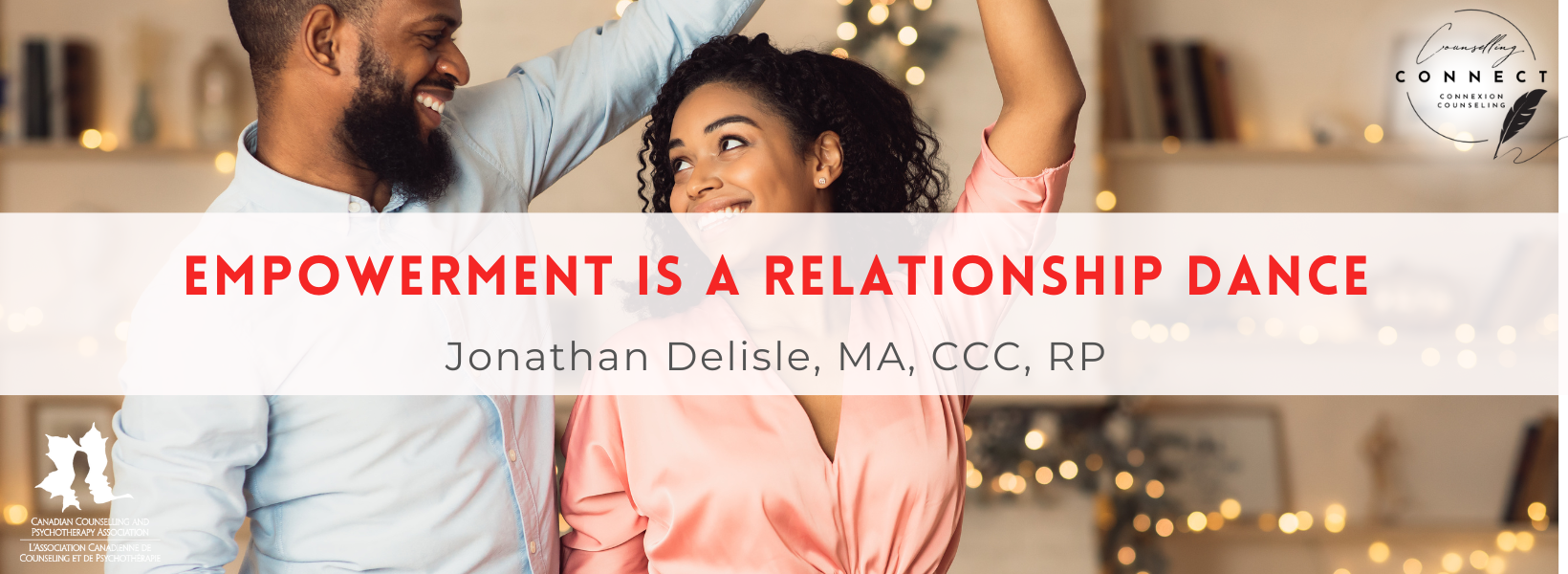
For those of you who’ve taken dance lessons, you know that a big part of learning a dance is mastering the footwork, especially when dancing with a partner. In order to perform smooth and graceful steps, you have to be able to move in sync, asserting your steps and allowing your partner to assert theirs, always flowing and never colliding.
A healthy relationship is just like that: two individuals who welcome each other in their personal space, neither overstepping the other’s boundaries nor allowing themselves to be stepped on. Two people in a healthy relationship can be vulnerable with each other, yet secure that the other will have their best interest at heart and never mean to hurt them. If one of them does step on the other’s toes, the transgressor quickly and simply apologizes, resumes his or her place, and the dance continues.
A saying I’ve told many clients is that a relationship is meant to be a dance, not a wrestling match. We’re supposed to work together to help each other flourish into the best version of ourselves, not beat the other into submission of what we think their role should be in our relationship. It requires an ability to be ready to respond to the other’s needs, to be ready to compromise on anything except our very core values, to humbly admit when we are at fault.
My wife and I have a saying when tempers get tense between us. One of us will invite the other to step out of the boxing ring and onto the dance floor. Having taken Muay Thai classes as a family (a form a kickboxing), the image is real for us. When in the ring, one tries to exploit the opponent’s weaknesses and blind sides to land successful blows. The match ends when one wins and one loses.
The problem with the boxing ring approach in a relationship is as follows. First, you see the person with whom you are meant to have this healthy relationship as an adversary or an opponent. The trust is compromised and you feel the need to protect yourself from them. Respect gives way to fear and/or anger. Second, when one of you loses in the conflict, it doesn’t matter who won because the relationship lost. You not only stepped on your dance partner’s toes, you threw them onto the floor, bringing the dance to a complete stop. Someone got hurt, trust has been broken, and so both partners step away from each other emotionally.
Now let’s go back to the image of an empowering relationship being a smooth, graceful dance. No relationship is without struggles, so it will never be this entirely flawless dance. Still, even in the midst of struggles, we can continue to flourish into what author and speaker Matthew Kelly calls the best version of ourselves.
For whatever relationship in which we find ourselves, we can be an epicenter of empowerment for each and every one of them, thus being the best version of ourselves and bringing others to be their best as well.
As a spouse I can learn from the disagreements with my spouse to patiently listen to their version of the facts, to put their needs before my own when called for, to humbly accept and acknowledge when I was in the wrong. As a friend, I can welcome unconditionally the other friend to vent their feelings or thoughts when needed, go out of my way when possible to make the other’s life a little easier. As a co-worker, I can be this colleague who has my colleagues’ backs when the workload gets especially heavy, or this manager or supervisor who always tries to make the time needed to help others succeed or to validate their hard work when I could easily fixate on my own and let them be. These are but a few examples or the myriad I could list.
If I take a look at any relationship in my life, and there are as many as there are people in my life, what dynamic do I see? Am I engaged in this invigorating dance, or am I caught up in a struggle for dominance and control?
*The views expressed by our authors are personal opinions and do not necessarily reflect the views of the CCPA