Dungeons and Dragons: The Wii Habilitation of Video Game Therapy

Posted by: Priya Senroy on July 12, 2013 1:03 pm

Hello readers!

I hope that you are spending as much time as outdoors as possible whenever you are able to take time away from work or in my case from video games. Am I getting addicted…..hope not but playing Dungeons and Dragons has definitely picked my curiosity and all this because I wanted to research it for a case. A client of mine has been grappling with cyber addiction and in my quest to find out what it is….I have succumbed to it too..

Interestingly…..it’s not as bad as it seems. Did you know that Video games have found their way into the clinical care of youth in most medical fields, and academic interest in their use is increasing steadily? The popularity of video games among youth may qualify them as a useful tool in psychotherapy for children and adolescents (Ceranoglu., 2010). In fact, psychotherapists and counselors have started using this medium as an assessment, intervention as well as rehabilitative tool while working with adolescent clients.   Now I found that there were not much research available in this area and there were few article on this subject so there is not evidence based practice to support the efficacy.

Studies have been conducted using it to teach focusing skills to children with ADD  to using it as a rehabilitative tool while working with patients with Parkinson’s disease, In fact  it called Wii Habilitation.

But what interested me the most was a portion of an article which states that certain games, which are still in clinical trial have physiological sensors that are built into the game hardware which allows  players  to  learn how to monitor the physiological manifestations of anxiety and stress, or what is commonly called their “fight or flight” response. The players use those same sensors as controllers to move themselves through the game by monitoring and controlling their characters and the stress responses they represent ( Sugarman, 2011).

So with  the new found knowledge I am trying to discover for myself the ‘benefits’ of being a gamer ,  get better understanding of my client as well as use it as a part of my counselling tools and techniques

Further Readings

http://www.apa.org/pubs/journals/releases/gpr-14-2-141.pdf

http://usatoday30.usatoday.com/tech/products/games/2005-09-26-video-game-therapy_x.htm

http://abcnews.go.com/Health/video/wii-rehab-video-game-therapy-nintendo-xbox-kinect-motion-based-conrol-games-parkinson-desease-treatment-11315981

http://psychcentral.com/news/2011/08/29/computer-game-therapy-combats-stress-anxiety/29004.html


*The views expressed by our authors are personal opinions and do not necessarily reflect the views of the CCPA
Digital Career Literacy

Posted by: Dawn Schell on July 12, 2013 12:41 pm

I can’t avoid it any longer.  I’ve talked about it enough.   The time for action has come!

When I read “Building Online Employability – a guide for academic departments” by Longridge, Hooley and Staunton[1] I was reminded of how important it is for me as a career development practitioner to be digitally career literate.  

What is digital career literacy?  To quote the authors, “…an interlinked set of technical skills, career management and employability skills”. They go on to say, “Digital career literacy is already important to an individual’s ability to pursue a career successfully, but it is getting more important.”

Continue reading


*The views expressed by our authors are personal opinions and do not necessarily reflect the views of the CCPA

Report Cards – To Praise or Not to Praise?

Posted by: Hailing Huang on July 9, 2013 4:05 pm

The end of June has arrived, and with it is the end of another school year; kids bring home their report cards with joy or with sorrow. Chinese parents, whether they are in China or in Canada, always seem attentive to their children’s report card.

A few days ago, I spoke with a friend in Fuzhou China, she said: “This is the last year of my son’s elementary school, even though he performed well during the whole school year, the last exam will determine which school he will go to for junior high.” The last exam means a lot for students and their parents in China. Yesterday, a local Chinese parent, asked me: “Do you mind if your daughter get Bs?”  It seems Chinese parents are always on the alert when it comes to their children’s grades.

This phenomenon reminds me of Amy Chua, the author of ‘Tiger Mom’, when she said, that she demands excellence from her daughters; she assumes the strength rather than fragility. We may not agree with Amy Chua’s harsh discipline, but the reason behind her action may ring a bell for most Chinese mothers: the common desire of having high academic expectations for their children.

Continue reading


*The views expressed by our authors are personal opinions and do not necessarily reflect the views of the CCPA

A Summer Reading List

Posted by: Dawn Schell on June 28, 2013 3:51 pm

Summer is fast approaching and we have a tradition in our household of setting summer goals.  Trails we want to hike, new places to explore, farmers’ markets, days at the beach and, of course, the ubiquitous summer reading list.  Ah, summer!

It’s not all fun and games or light summer fiction.  Here’s what’s on my serious summer reading list.

In May the American Telemedicine Association released their new “Practice Guidelines for Video-based Online Mental Health Services.  You can download the guidelines for free here – http://www.americantelemed.org/practice/standards/ata-standards-guidelines/practice-guidelines-for-video-based-online-mental-health-services

While you are there you may want to check out their other resources.

Call me strange but I will also be cruising through Azy Barak’s Index of References related to the Internet and Psychology looking for articles that attract my attention.  Such an excellent resource. 

http://construct.haifa.ac.il/%7Eazy/refindx.htm

An issue that has been coming up in the past while with clients is video game addiction.   So I will be reading more about it on Dr. Brent Conrad’s site http://www.techaddiction.ca

and on Mike Langlois’ site http://gamertherapist.com/blog/gaming-and-therapy/

 That should take care of the summer.   After all I still need time to do all those other summery activities!  

Dawn Schell, MA, CCC, CCDP is an affiliate of Worldwide Therapy Online, Inc.  http://www.therapyonline.ca


*The views expressed by our authors are personal opinions and do not necessarily reflect the views of the CCPA

Eco Mapping

Posted by: Priya Senroy on June 28, 2013 3:47 pm

In trying to make my session not so talkative I have many times incporrated genograms while doing intake-I recently came to discover Ecomap and I must say that it has made some of my non creative sessions more interesting. I think as it is not used as an intake but more as an ongoing process to determine the current functioning and relationship of a client, I find it more fuild and organic as a process. I have taken it a step futher ad have inforporated mind mapping techniques to make it more visual and creative.

So want is eco mapping? One defination goes like this Ecomap is a a family assessment tool consisting of a graphic representation of a family relationship with its environment (The free medical dictionary by Farlex, 2013). Developed by Dr. Ann Hartman in 1975 as a way to graphically represent the different systems in an individual’s life and to diagram how those systems affect the individual. They are primarily used in counseling to evaluate the healthy or unhealthy relationships that an individual has with each system in his or her life.

More information can be found in

http://www.strongbonds.jss.org.au/workers/cultures/ecomaps.pdf


*The views expressed by our authors are personal opinions and do not necessarily reflect the views of the CCPA

RESPECTFUL Counselling Cube

Posted by: Priya Senroy on June 28, 2013 3:44 pm

Hello readers, in my effort to learn new skills  and incorporate  that in my practice, I was recently introduced to something called the RESPECTFUL Counselling Cube.  I am still in the process of integrating it in my practice and if anyone has tried it successfully I would be interested in learning more.

The RESPECTFUL counselling framework is a model that introduces a new way of perceiving individuals who are involved in the practice of counseling – those seeking assistance and practitioners such as counselors and psychologists. This framework involves two basic assumptions. The first involves the belief that the eventual aim of counseling is to enhance and develop the client’s improvement in all aspects. The second involves the recognition of the fact that human development is complex, multidimensional, and unique. Both assumptions are essential in addressing the needs of adolescents, who are considered to be a vulnerable population in today’s society

The RESPECTFUL framework can be applied in the counseling especially because it focuses on the following factor ‘s of an individual ‘s development (R ) religious-spiritual identity (E ethnic-cultural-racial background (S ) sexual identity (P psychological maturity (E ) economic class background (C chronological-developmental challenges (T ) threats to one ‘s personal well-being (F ) family history and dynamics (U ) unique physical characteristics , and (L ) location of residence (D ‘Andrea Daniels 2000).

More information can be found in

 http://www.counseling.org/Resources/Library/VISTAS/2009-V-Print/Article%204%20LeBeaufSmabyMaddux.pdf

www.coedu.usf.edu/zalaquett/mt/Building%20Multicultural%20Allies

This video is also informative

http://www.youtube.com/watch?v=9jYY_flbZ3o


*The views expressed by our authors are personal opinions and do not necessarily reflect the views of the CCPA

The Little List of Self-Care Tips for Online Counsellors

Posted by: Dawn Schell on June 13, 2013 11:18 am

A friend has been preparing to teach a university course on trauma to counsellors and we’ve been discussing our ethical responsibility to engage in self-care.  Which led me to re-examine my own self-care practices.  Besides all the “usual” ones – what I noticed is that doing online counselling requires an additional set of physical self-care strategies.  Ones that, sadly, until recently I had been neglecting.

Here’s a few of the self-care tips I have re-discovered.

Ergonomics

I have been reviewing the proper desk height and computer positioning using the Mayo Clinic guide.  Hmm…looks as if I need an office makeover.   

http://www.mayoclinic.com/health/office-ergonomics/MY01460

Though one thing I have done correctly (ergonomically speaking) is this – I have an awesome completely adjustable chair.   Well worth every penny I spent on it.

Other people I know who do this work sit on a balance ball.  And one person I know has a standing workstation.   It’s about finding what works for you.

Continue reading


*The views expressed by our authors are personal opinions and do not necessarily reflect the views of the CCPA

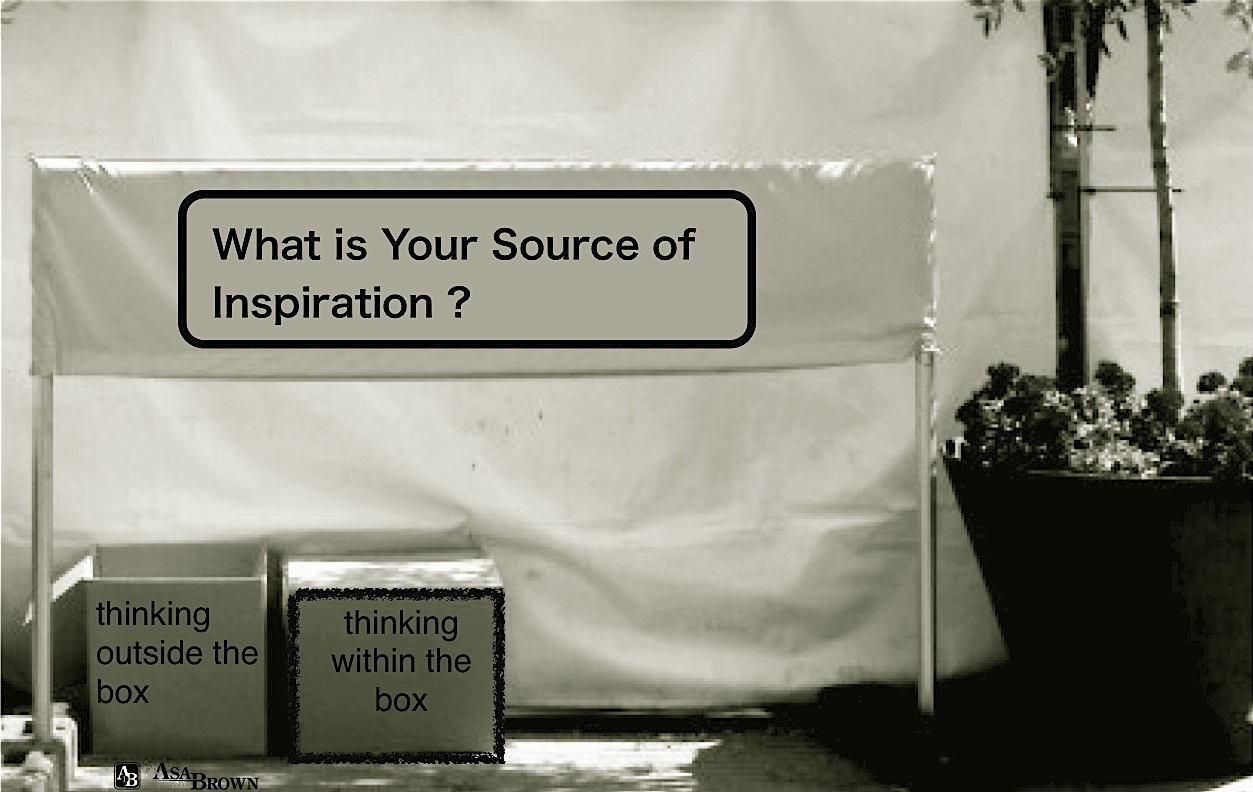
What is Your Source of Inspiration?

Posted by: Asa Don Brown on June 11, 2013 4:42 pm

“The whole history of science has been the gradual realization that events do not happen in an arbitrary manner, but that they reflect a certain underlying order, which may or may not be divinely inspired.”
 ~ Stephen Hawking

What is your source inspiration? What or who inspires you to live and prove productive?  Is your source of inspiration a person, a place or thing?  If so, what is that source of inspiration?  Are you inspired by a spiritual being or religious ideological viewpoint?  Is your inspiration your soulmate or an important friend?

Why is it important to be inspired? Whether you are inspired by another individual or something within your own person; inspiration is the motivator within life. Inspiration is the catalyst for prodding you forward.  What is the importance of inspiration?  If we are inspired, we will inspire those around us.  Inspiration beseeches inspiration.

Continue reading


*The views expressed by our authors are personal opinions and do not necessarily reflect the views of the CCPA

The Inner Journey

Posted by: Hailing Huang on June 6, 2013 3:38 pm

If the inner journey is the fundamental element of the spiritual path,  how  then  do we venture upon a path that can evoke the life force within us?  The world has dramatically changed from what it was fifty years ago, or five hundred years ago, however, the inward journey, the path toward maturity remains the same. By studying, and learning from these old wisdom teachings, we can acknowledge the paths of those heroes, the kinds of life quests they faced, how they felt when they faced these cross roads.  What was the life force that helped them overcome obstacles and achieve their goals? Acknowledging and learning from the old stories can provide us with a road map for our life journey. Embracing the greatness is the first step of the spiritual journey; in order for transformation to take place.

If we picture ourselves as a traveler, then to ensure that we reach our desired destination there are three essential tools that we need to gather together before embarking on the journey.  First, obtaining a road map; second, understanding the roadblocks and the third is finding a lodge for the traveler to rest.  A traveler of an inner journey requires these same tools.  

How do we get this map for our inner journey?  I think it can be discovered, and defined through your iconic figure. First, to identify your hero, ask yourself the question: who is my hero? Then study and clarify your hero’s journey.  Second, what are the roadblocks on the inward journey? They can be interpreted as challenges, temptations, and barriers that may cross your path. Furthermore, it should include the aids that the traveler or hero received and the resources they relied on. These challenges and barriers function like traffic signals, such as red, yellow or green lights which lead us to overcoming the barriers and to pass through the threshold of each of the psychological stages.

Continue reading


*The views expressed by our authors are personal opinions and do not necessarily reflect the views of the CCPA

Yoga Psychology

Posted by: Priya Senroy on May 31, 2013 3:57 pm

Dear Readers

Happy Mid Spring!!!!

I have been trying to motivate myself in shaping up for summer and have been thinking of joining Yoga. I practice it when I was young in India but did not like it and obviously did not understand the benefits of it.  So when I recently went to an open house, I heard the word Yoga Psychology and that tweaked my interests. I pondered about how this ancient form of physical activity could have psychology build into it and how can something as diverse as yoga is a part of psychology? While researching I came across an article in the American Psychological Association website which quotes-Studies show the practice( of Yoga)—which combines stretching and other exercises with deep breathing and meditation—can improve overall physical fitness, strength, flexibility and lung capacity, while reducing heart rate, blood pressure and back pain. But what is perhaps unknown to those who consider yoga just another exercise form is that there is a growing body of research documenting yoga’s psychological benefits. Several recent studies suggest that yoga may help strengthen social attachments, reduce stress and relieve anxiety, depression and insomnia. Researchers are also starting to claim some success in using yoga and yoga-based treatments to help active-duty military and veterans with post-traumatic stress disorder. It shares that there are  counselors, therapists and analysts  who have been using Yoga in their practice and while it must be noted that while  teaching yoga to clients without formal training is not the way to go ,  but psychologists or even counselors  can use psychotherapy sessions to practice yoga’s mind-body awareness and breathing techniques. Simple strategies—such as encouraging clients to get as comfortable as possible during their sessions or to pay attention to how their body feels when they inhale and exhale—teach clients to be in the here and now.”These by themselves would be considered yoga interventions because they direct attention to the breath and help unhook people from thoughts, emotions and impulses that are negative or destructive,” says Kelly McGonigal, PhD. Stanford University health psychologist and yoga instructor.

So with this new found knowledge about yoga I will definitely learn and practice the breathing teching and try to use it with my clients and incorporate that while opening or closing sessions. For more information , http://www.apa.org/monitor/2009/11/yoga.aspx  has information and so does these books.

Ajaya, S. (1984). Healing the Whole Person: Applications of Yoga Psychotherapy.

Honesdale, PA: Himalayan Institute Press.

Shannahoff-Khalsa, D. (2006). Kundalini Yoga Meditation: TEchniques Specific for Psychoatric Disorders, Couples Therapy & Personal Growth. New York: W.W. Norton & Company.


*The views expressed by our authors are personal opinions and do not necessarily reflect the views of the CCPA