What is a Social Justice Approach to Advocacy Counselling?

Posted by: Priya Senroy on March 18, 2014 12:42 pm

This month is all about waiting for Spring and being surprised by digging myself out of the snow…again and again…almost to the point of being internally oppressed by winter and not taking a more proactive role in dealing with the world….. Resigning to the internal oppression and not be an advocate for my personal wellbeing….speaking of advocacy, I attended a lecture on the subject of looking at social justice approach to advocacy counselling- a new subject area for me except t few words… At the end of the lecture, I was fascinated by the take….so here is my understanding along with the experts…..

A social justice approach to advocacy counseling involves advocating for clients within their many social systems, modeling empowering behaviors by teaching clients how to access services, and encouraging clients to become advocates for themselves within their communities (Toporek, Gerstein, Fouad, Roysircar, Israel, 2005). The goal of advocacy counseling is to increase clients‟ feelings of self-empowerment and belongingness (Lewis & Bradley, 2000; Lewis et al., 2003). Specific techniques of advocacy counseling involve, but are not limited to, encouraging clients to join self-help groups; imposing class advocacy, which involves speaking out on clients‟ rights (Lee & Walz, 1998); and consulting with individuals, communities, and organizations. According to Kiselica (1999) and Lee (1999), counsellors who ascribe to a social justice model understand and validate their clients‟ reality and empower their clients to take a more active role in resolving their own issues.

For example; On an individual level:  A Client who has experienced sexual harassment in her worksite and would like to address it but does not know how, can be counselled to take the empowerment approach and the advocacy approach to start to raise awareness not only for herself but also for her peers. On a community/organizational level:  A counsellor observes a number of clients who have experienced similar barriers in the community. They can take the community collaboration and the systems advocacy approach to mobilize resources in the community to address those barriers.. On a societal level:  A counsellor works with clients who experience difficulty obtaining adequate parental leave can access public Information and critique social/political policy.

There is a plethora of information out there and some of the thoughts; the references shared in this blog can also be found in

http://www.psysr.org/jsacp/lewis-v3n1-11_5-16.pdf

http://www.psysr.org/jsacp/hof-v2n1-09_15-28.pdf

http://www.psysr.org/about/pubs_resources/jsacp/Green-V1N2-08.pdf


*The views expressed by our authors are personal opinions and do not necessarily reflect the views of the CCPA
When Technology Fails

Posted by: Dawn Schell on March 17, 2014 7:00 am

Ah, technology.  Wonderful when it works the way you expect!  However, when you are engaged in online counselling at some point you will have one (or more) of these experiences.

Something you have spent hours on ‘disappears’.  Passwords get forgotten.  Video doesn’t work.  Audio is not audible.  Save buttons don’t save. Servers go down.  Internet connections fail.  Computers crash.  Backups don’t backup.  Power goes out.

These three words go a long way to making it easier to deal with –  Plan, prepare and inform!

Give serious thought to how you will handle technological problems.  Make a plan for every possible type of issue.  If you have trouble coming up with a list ask anyone you know with a techy mind to help you generate ideas.  Believe me they will have ideas!

Ensure you have client contact information in a secure location– phone numbers, email addresses and whether or not you can leave a message. Every time you start working with a new client be sure to print out their contact information.  Printing it out means it’s accessible to you in the event your computer is the one that crashes.

Ensure clients have a way to contact you.   Do they have your work phone number?  I always include mine in my initial welcome/housekeeping message.

Let clients know ahead of time what will happen if there is an interruption in service.  Clearly outline who will do what within what time frame.  If need be, bring it to their attention more than once.

For example, in their guidelines for communicating during a computer system failure, Nottingham Trent University states, “If your computer system fails and you cannot send or receive emails you will need to contact us immediately by telephoning (number).  When we receive a phone message from you, we will suspend the online counselling process until you inform us that your computer system is working again. Once we receive the information that your system is working we will reschedule another online appointment with you.

If our computer system fails and we cannot send or receive emails, we will contact you by phone and inform you of our system failure.  Once the system is working again we will contact you by email informing you that we can recommence the counselling process.”

Other online counselling sites I have seen also suggest both parties (counsellor and client) assume positive intent.  By that they mean – don’t assume your counsellor/client is upset with you and so has stopped communicating.

Technological problems will happen.  I guarantee it.  Usually when you least expect it or when it is most inconvenient!

Be prepared isn’t just a good motto for Scouts.


Dawn M Schell, MA, CCC, CCDP is an affiliate of Worldwide Therapy Online Inc. http://www.therapyonline.ca


*The views expressed by our authors are personal opinions and do not necessarily reflect the views of the CCPA

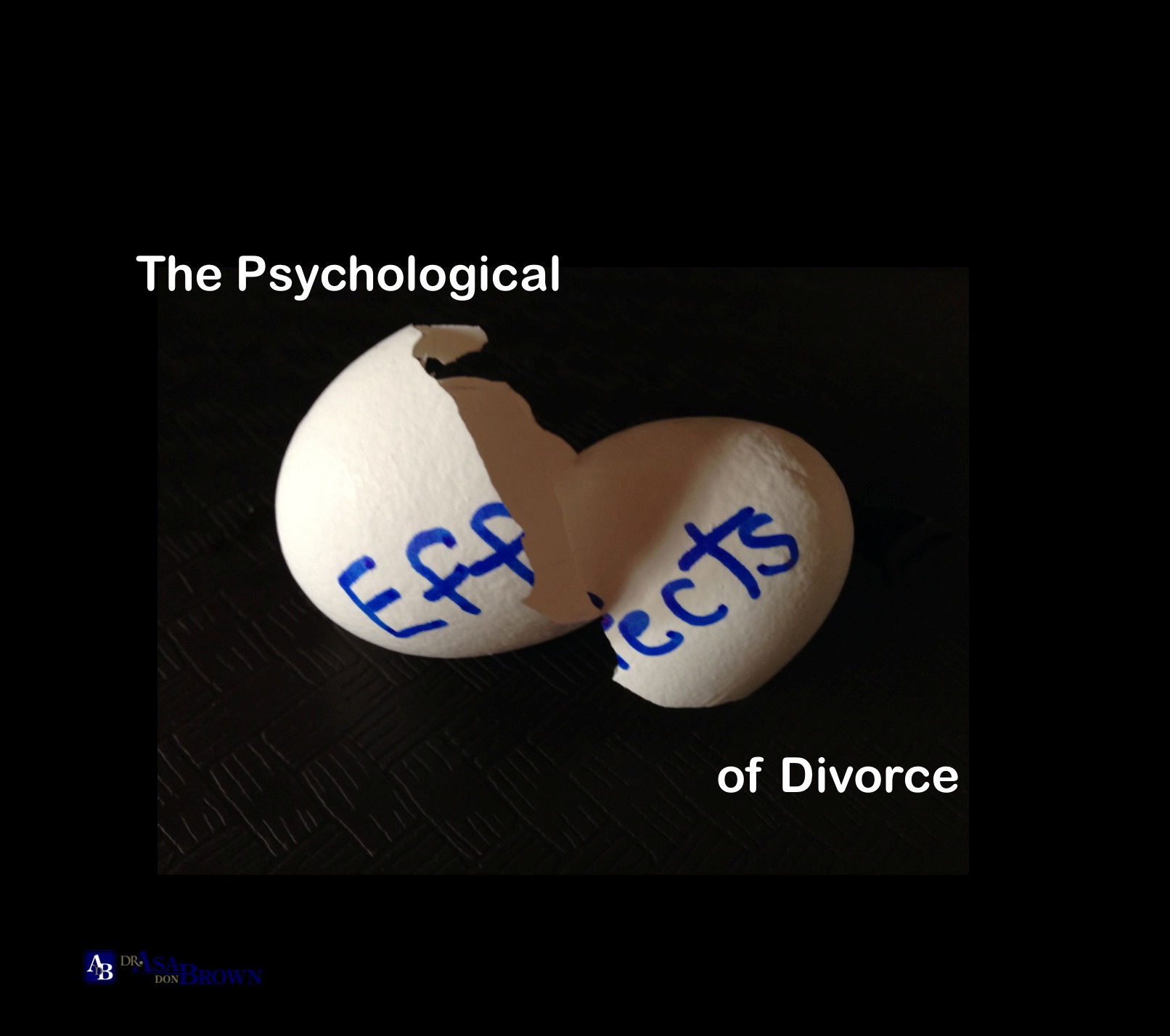
The Psychological Effects of Divorce

Posted by: Asa Don Brown on March 17, 2014 7:00 am

“When mom and dad went to war the only prisoners they took were the children.”
~ Pat Conroy

As a child of divorce, I can confer that the legal separation and dissolution of a marriage can have a profound effect. Even if, your parents are splitting amicably, having the greatest spirit of friendliness and acceptance; the separation of a set of parents has an effect. The level of the effect will and may differ, dependent upon the rationale behind the divorce, and the outcome of the divorce proceedings. While on the judicial side, divorce is the legal dissolving of a relationship; divorce from the perspective is the removal of one parent from another.

Divorce not only effects the children, the parents (the couple), but has an ability of effecting those beyond the confines of the immediate relationship. While divorce has an effect, it’s effect will vary dependent upon the family and the ultimate dynamics of the relationship .

THE EFFECT OF DIVORCE

Divorce can have a dire effect on all members of the family. The repercussions of a divorce can have an impact on the families financial stability, social environment, academic and employee performance, and the psychological and physical well-being of the family. Please understand, I am not criticizing divorce, rather it is important to recognize the possible and often frequent ramifications of divorce. While the ramifications and outcome of divorce are often egregious in nature; the ramifications and outcome of remaining in a negative, abusive, unaffectionate or undesirable relationship, can have a significantly greater effect.

“First, children who grow up in an intact, two-parent family with both biological parents present do better on a wide range of outcomes than children who grow up in a single-parent family. Single parenthood is not the only, nor even the most important, cause of the higher rates of school dropout, teenage pregnancy, juvenile delinquency, or other negative outcomes we see; but it does contribute independently to these problems. Neither does single parenthood guarantee that children will not succeed; many, if not most, children who grow up in a single-parent
household do succeed.” (Berlin, 2004, Online)

The Typical Concerns Associated with Divorce

1) What is the probability that my child will develop feelings of abandonment?
2) Does my child blame me for the divorce?
3) Will my child blame himself/herself for my divorce?
4) What is the probability that my child may develop psychological concerns because of the divorce?
5) As a parent, will I have the ability to have equal time and custody of my child?
6) How do I reassure my child that I will not abandon him/her?
7) How do I reduce the level of stress involved with the divorce?
8) How do I show respect for someone that I detest?
9) What is the probability that the disruption of the family routines will effect my child?
10) What if, my child show’s no signs or symptoms pertaining to the divorce?

Continue reading


*The views expressed by our authors are personal opinions and do not necessarily reflect the views of the CCPA

So What’s Your Creative Quotient?

Posted by: Priya Senroy on March 15, 2014 12:39 pm

I think this winter has zapped my creativity and the only canvas I see around me is white…every time I try to infuse color…BAM comes the snow and wipes it clean…even my children are saying my food is not colorful…so have I lost my mojo or winter is just an excuse not to be creative….so I came across this website that I was exploring with a client around career assessment  on creative quotient…and I thought to myself…well mine must be zero at this time and I surprised myself with a   57%–

So what is Creative Quotient or CQ….well…Just as IQ and EQ has proven to be measures of specific capabilities, the capacity for creativity is increasingly the core to building value in these uncertain and treacherous times. And just as IQ and EQ scores can be raised significantly for anyone by teaching and training, so too can CQ be bolstered for clients, individuals and organizations. Perhaps we can use CQ as an assessment/evaluation tool in our counselling process

I do not know if  such tests  are right or wrong, valid or not  and I definitely  do not know the scientific validity behind it or if it is backed by best evidence based practice ,but it was interesting to think of the questions-even though I did not take it for my career exploration-it might be worthwhile to try it to get over the creative blah if anyone is feeling up to it..

It has definitely raised my mojo and now I am striving to see how I can improve it further.

So the websites where these tests and more information can be found are:

http://assessments.firstnaukri.com/

http://www.edu-nova.com/apps/creativity.html

http://www.centreforthemind.com/publications/CQPaper.pdf

http://creativityforlife.com/your-creativity-quotient-how-to-boost-it/


*The views expressed by our authors are personal opinions and do not necessarily reflect the views of the CCPA

Real-Time Adventures in Counselling Private Practice – Chapter One

Posted by: Rhea Plosker on March 12, 2014 4:11 pm

The most difficult thing is the decision to act, the rest is merely tenacity. (Amelia Earhart)

I am in the process of building a counselling career after 25 years (more or less) as an engineer in the corporate world, including 10 years as an independent consultant. There are a number of reasons why I pursued a counselling career in mid-life but, at the core of it, what I love most about the business world is the emphasis on team work. This passion became a calling to explore new and deeper forms of human collaboration. I enjoyed my Master of Counselling program at Athabasca University, taught through collaborative online interactions rather than one-way lectures. My practicum at Providence Healthcare, a Toronto-based rehabilitation hospital, provided an inspiring multi-disciplinary collaborative environment, where social workers, physicians, nurses, occupational and physical therapists, dieticians, speech language therapists and one counselling student (me!) worked closely with patients and families.

Upon graduating, a combination of private practice and volunteering seemed the right fit for me. I had the idea of pursuing a professional development model common in the corporate world—an internship/junior position with an experienced supervisor. I would become a better counsellor by watching, doing, and receiving feedback. My supervisor’s practice would be enriched through collaborative work, and would benefit financially through seeing more clients, paid supervision, and cheap help. I am drawn to post-modern therapies and assumed that therapists must regularly collaborate with each other or how would reflecting teams and outsider witness practices be possible!?

I learned quickly that private practice therapists supervise and consult other therapists, but direct collaboration is less common. Potential supervisors offered to review audio/video of my sessions but wouldn’t let me see them work directly with clients.  One person gently told me that internships or junior staff made no sense for private practices, and many people simply didn’t return my calls and emails. I realized I had entered a different cultural landscape. Private practice was starting to seem like a very lonely way of making a living.

I asked Trish McCracken from the CCPA for advice, and she was generous with her ideas and time. She suggested exploring AAMFT supervisors. I followed her advice and found William Cooke (www.williamcooke.ca). William is a Narrative Therapist, and has had two previous successful experiences with collaborative supervision in his practice. Similar to me, William also had challenges gaining support for this approach, including being turned down as a supervisor by a social work program that didn’t support student placements in private practice.

I do know that other private practices are engaging in collaborative work but it seems to me that this way of working is still the exception rather than the rule. As I blog about my private practice adventures, I hope to hear from others about their collaborative experiences, both good and bad.
Rhea Plosker is an Engineer and Counsellor. She is starting her adventures in private practice with www.williamcooke.ca and also works as a project consultant in health care and not-for-profit organizations. Rhea can be reached at [email protected] or at www.inspirationsolutions.com.


*The views expressed by our authors are personal opinions and do not necessarily reflect the views of the CCPA

Culture as a Chronic Stressor

Posted by: Farah Lodi on March 12, 2014 4:06 pm

When we think of culture, we usually think about language, food, art, customs and rituals. Culture is the spice of life and generally enriches our lives, right? That’s one way to view culture.

But sometimes teenagers and young adults feel conflicted by the differing demands and expectations of the globalized monoculture versus their own culture. And I’m not just talking about minority cultures – even in communities where the dominant culture is conservative or collectivist, many people are still influenced by the appeal of Western pop-culture. Erik Erikson described the driving force for adolescents as individual identity versus identity confusion. Many of my clients readily identify as coming from traditional, conservative cultures, seemingly comfortable with this view of self. But the reality is that culture is a chronic stressor in their lives. The World Health Organization has described depression as the next global epidemic. I believe culture-based stress is a factor leading to high rates of mental and emotional problems.

In my practice I see teenagers who are taught to respect their parents above all else. Some develop codependency traits as they focus on family needs and neglect their own needs. Their sense of self is  closely tied to heritage – but they are pulled in an opposite direction when seduced by the allure of independence, individualism and fewer boundaries. Tasting the pleasures of forbidden fruits triggers the cycle of excitement, guilt, and shame. Rather than the spice of life, culture becomes a red-hot chili pepper, stinging and burning as they try to make sense of this internal conflict – the tug of war between loyalty to culture, or to self.  This dissonance manifests as anxiety and depression. Their culture is a stressor.

Another group of my clients are depressed single women in their late thirties, stigmatized by their cultural view that a woman’s identity should be linked to being a wife and mother. In counseling these clients present with secure early attachments, no apparent traumas, no other external stressors – aside from cultural expectations which become triggers for low self-worth.

In my view, the evolutionary process of adaptation needs to be applied to culture as well. I’m not endorsing a melting pot – I’m just saying that black and white thinking can lead to stress. So I ask my clients if they can be a bit more flexible with their beautiful cultures, hold onto basic values, but be a bit more accepting of change and different environments. Live life in the grey area……it’s more palatable.


*The views expressed by our authors are personal opinions and do not necessarily reflect the views of the CCPA

The Essential Documentation Needed in Your Private Practice

Posted by: Andrea Cashman on March 10, 2014 4:39 pm

There are certain administrative requirements that are mandatory to operate your counselling private practice. These include documentation for client files such as a consent form for treatment, an intake form, session notes and payment receipts. I find these are the four that I use the most.

Writing session notes are essential because it is your professional and ethical duty to track the progress of your clients. It is up to you what to include in your notes. Keep it factual. If you were ever subpoened in a court case, chances are your notes will be. Personally, I make sure to write any treatment I have provided in addition to my assessment and observations of the client in session. A good format to try would be the SOAP format. I learnt this back in nursing school and it’s a great tool to use. SOAP stands for subjective, objective, assessment and (treatment) plan. Here is an example: http://www.ehow.com/how_6120666_write-case-notes-soap-format.html

An intake form is given to the client at the first session to fill out. It provides more information for the counsellor. It will be up to your discretion what you decide to include in your form; however, this is where research will help you decide. I think it is great to include client demographics, psychiatric and medical conditions, an emergency contact, previous counselling and what worked/didn’t work, who their GP is, their view of their presenting issue and what short and long term goals they would like to acheive in therapy.

Continue reading


*The views expressed by our authors are personal opinions and do not necessarily reflect the views of the CCPA

Unplugging

Posted by: Dawn Schell on March 10, 2014 4:27 pm

“Can’t be done”
“No way”
“That’s terrifying”
“Why would I do that?”
“No, I won’t”
“Hunh???”

These are just a few of the reactions I received when I recently broached the topic with some youth about unplugging from all things digital for a 24-hour period.

It’s not a new idea.  A couple of years ago 1,000 students from 10 countries took on the assignment of doing without the Internet or phones for 24 hours.  The results of that study were interesting. You can check it out here – http://theworldunplugged.wordpress.com.

What prompted me to revisit the idea of a digital-free day was learning about National Day of Unplugging[1] (NDU).  It’s a day to completely unplug from phones and computers.  No texts, no emails, no mindless surfing of the web.

The NDU is the brainchild of Reboot[2], a non-profit in the USA.  Reboot created the Sabbath Manifesto[3] – “a creative project designed to slow down lives in an increasingly hectic world”.  Reboot invites everyone, regardless of religious affiliation, to “carve a weekly timeout into our lives”.

Considering how “overconnected” we can all be it seems wise to take time away from the devices.  For example – counting up the devices in own household was eye-opening.  In a household of four we have five cellphones, one iPod, six laptops, one desktop and two wireless networks.  Talk about overconnected.

Unplugging for just a day may not seem like much but it is a start.  If you check out the NDU website you will see that people from all over the world have taken the unplugging pledge.   Youth and older adults are signed up and the reasons they say they want to unplug range from sweet to funny to poignant.

How about it?  Take the National Day of Unplugging Pledge for 24 hours starting at sunset March 7 and running through to sunset on March 8.  I’m going to and I’m going to recommend it to my clients too.
Dawn M. Schell, MA, CCC, CCDP is an affiliate of Worldwide Therapy Online Inc.  http://www.therapyonline.ca


*The views expressed by our authors are personal opinions and do not necessarily reflect the views of the CCPA

SLCHG Pilot Project: Design, Launch, Conflict + Human Factors

Posted by: Linda AK Thompson on March 10, 2014 4:21 pm

PROJECT DESIGN:  February 2013 to Launch of November 2013
Project Time Frame:
  November 2013 to November 2017
Candidate Participants:
7 females  – mid-twenties to 50+ [mean 56].  6 Canadian; 1 American
SLCHG-Core Practitioners:  4 – 1 Trauma Counsellor, 1 Naturopath/Chiropractor,
1 Classical Naturopath + 1 Body Therapist/Intuitive Healer
3 PHASE HEALING-TO-CURE PROGRAMS: 
Entry Program
:  Intake, Significant/Traumatic Lifetime Events History, Crisis + Critical . Occasion Stabilization, Medication Review, Symptom Complex [SC].  Graph, Pre-Treatment Assessment , Establishing Collaborating Team + SC Dissipation + Stabilization [able to contain]
Fulcrum Program
: Stabilized, attending, engaged + compliant with collaborating core + local practitioners with ability to decompress/contain/maintain basic  stability/ADL function while processing/integrating trauma memories between treatments sessions
Cure Program : Feels trauma vortex containers released, reconciled with historic TLE,    . majority of traumatic bereavement=forgiveness of self/others done. Working on positive sense of self / and has well enough worldview.  Able to adapt, self-regulate stressors + accommodates in situations, relationship with significant others, contributes @ home + work.                                                                                                                

Transition Program Option: treatment program suspended for an undetermined period of time as participant attends to acute medical issues, critical or crisis life events.                                                                                          

PRE/POST PROJECT ASSESSMENTS:
1) Mood Scale [4]
2) Braverman Nature + Deficiency Tests  [3 – pgs. 44-58]
3) Dissociative Experience Scale [DES] [12]
4) C-PTSD Criteria [10] Research Instrument [16]
5) Feeling Faces Inventory [FFI] Grief Work Instrument [14]
6) Draw-A-Core [DAC]: Projective Core Test [1997] – Personal Core Healing Work
7) 5 Symptom Complex Graph [SC Graph] Research Response Log [16]
8) Treatment/Progress Reports + Evaluations

PROJECT MATERIALS:
1) Trauma to Healing Vortex Collaborative Case File
2) Literature Reviews [Counselling Connect]
3) MOT: Homeopath Standing Orders:  Trauma-Specific SC Trials/Single Session Use [15]
Continue reading


*The views expressed by our authors are personal opinions and do not necessarily reflect the views of the CCPA

Making Peace With Your Past: Choosing Health and Happiness

Posted by: Asa Don Brown on February 27, 2014 12:00 pm

“A life lived without forgiveness is a prison.”
~ William Arthur Ward

Forgiveness is not only a state of mind, but it is a state of being.  It is woven through the very essence of our being.  Forgiveness is a constant attitude occurring through a purposeful action.  As humans, we are instinctively designed to forgive. It is only when we choose not to forgive that our minds, bodies, and spirits begin to experience disrepair.  Those who choose not to forgive, choose to harbor the wrongs of others and of their own person, frequently have physical and psychological signs.  Forgiveness cleanses the body, ridding it of the decay of negativity, disappointment, and heartache.  It is through the act of forgiveness, that we can live a balanced and well-adjusted life.  Forgiveness is the key to live life productively.

FORGIVENESS OF OTHERS

Forgiving others, especially our enemies is a challenge indeed.  What if, you had committed a wrong against another?  Would you not have deep desire to be forgiven?  Have you ever experienced the denial of your repentance?  What sort of effect did this have on your person?  Were you shattered by the unwavering and unyielding of the person or persons you had wronged?

As a clinician, I have met a variety of patients / clients who’s hearts ache to be forgiven.  As an individual, I too have had the experience of others denying the acceptance of my repentance.  The denial of our repentance can have a penetrating effect, plunging like a dagger deep into the very core of our being.  For so many, forgiveness and the lack of forgiveness can prove a major stumbling block.

If we deny accepting the repentance of another, then we are intentionally and purposefully hanging on to the wrongs of the past.  The wrongs of the past serve as a coat-of-arms.  We identify our coat-of-arms as a shield of honor, but the reality is, our coat-of-arms is shielding the very nature of our person from allowing others to enter.  It is serving as a warning sign, informing others to tread lightly, because I will remove them from my life, if they wrong me.

For people who long for the acceptance of their repentance, they will continue to be haunted  by their past wrongs as long as they choose to hang onto them.

WHAT REALLY IS FORGIVENESS?

“Forgiveness is not an occasional act; it is a permanent attitude.”
~ Martin Luther King, Jr.

Forgiveness is the intentional act or process of pardoning or offering absolution unto another.

Furthermore, it is the intentional act or process of accepting my own personal responsibility in an act or an event.  True repentance is expressed through sincere regret and remorse of our wrongs.  Therefore, I must forgive my own person, if I truly desire to heal from wrongful acts.  Forgiveness is a three way street.  It is the act of contrition, which is a state of feeling remorseful, sorrowful, regretful and penitent for the wrongs the we have committed.  It is also the responsibility of the person accepting our humbled and broken heart, that engages the act of forgiveness.  Most importantly, whether or not those we have wronged will accept our repentance, we must be willing to forgive ourselves.  For forgiving our own person allows the individual to move forward in life.  Unfortunately, not everyone will pardon or offer absolution of the wrongs we have committed.  Therefore, it is absolutely necessary that we forgive our own person simultaneously, when we request others to forgive the deeds or acts that we have committed.  Always remember, forgiveness is a continuous act not a momentary embrace.

Continue reading


*The views expressed by our authors are personal opinions and do not necessarily reflect the views of the CCPA