
Who Do You See in the Mirror?

Posted by: Asa Don Brown on November 10, 2011 4:27 pm

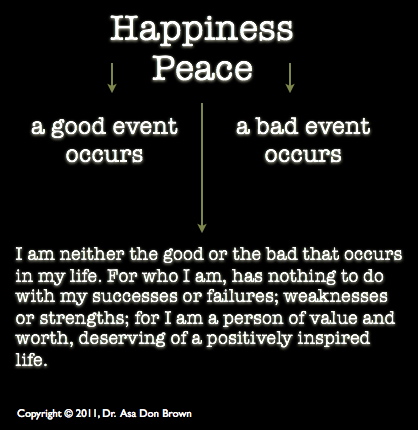
Who do you see when you look into a mirror?  Do you recognize the image of the person looking back at you? How long has it been since you really took time to view your own image?  Are you familiar with your body’s changes and maturation?   If not, how long has it been since you recall really seeing yourself?  

Teaching your children to be honest with themselves, begins with you.  As parents, we need to be honest with our own person.  If we avoid being honest with our person, then our children will learn a lesson that it is okay to be dishonest with ourselves.  If you are dishonest with another, you will know the truth, but you will have to live with that falsity.  Ironically, if you are dishonest with your own person long enough, then this dishonesty will become your accepted truth. 

When is the last time you submerged into you own person? How long has it been since you spent time intra-reflecting?  Has it been a while since you spent time reflecting on your inner and outer being? Have you been capable of integrating your outer being with your inner being?  It is a difficult task for many to see their outer person, much less their inner being. Why?  When we see ourselves outwardly, our physical appearance, we see what others may interpret us to be. It is difficult for people to face their inner-beings.  Not only is it difficult, but it is not uncommon for an individual to avoid facing their inner being.  When we think of looking inwardly, it is more common that an individual will think on the negative, rather than seeing positive aspects of intra-reflection.  For many, they will only see their flaws, blemishes, and the perceived negative changes that life has brought about.  Whereas, few people spend quality time looking at the dichotomy of our makeup, the good and the bad, the yin and yang.  If we desire personal growth and maturation, then we must be willing to go deeper than surface level, we must be willing to know and face our inner being. 

Continue reading


*The views expressed by our authors are personal opinions and do not necessarily reflect the views of the CCPA

Noticing positive clues leads to knowing when to say “Yes!”

Posted by: Mark Franklin on November 4, 2011 3:08 pm

When Gregg Brown worked in the restaurant business, he was asked to do training: “they plunked me in front of a flipchart and it felt very good.” He’s always been in training, from sitting his sister down in front of a chalkboard when they were kids, to his present role as Director of Training and Learning Solutions at SPM Learning.

Gregg is a certified member of Canadian Society for Training and Development, and was a recent guest on our Career Buzz radio show. You can hear the whole Oct. 26 interview with Gregg Brown

Listen carefully and you’ll hear Gregg’s successful career change strategy: “In my career, it’s been about being open and saying yes. It’s noticing what awakens that excitement or energy in you and you say, ‘I want to do that.’ And when you follow that excitement in your core it leads you down that [career success] path.”

Gregg urged listeners to tune into their own clues. “What revs you up? When you’re going about your day-to-day work and you read an article in a newspaper [about a career area], does it make you feel excited? Or not? Where’s that drive for you?” And then, when you notice those positive clues, Brown advised, “Know when to say ‘yes.'”

What’s your story of following positive clues in your career? Leave a comment!


*The views expressed by our authors are personal opinions and do not necessarily reflect the views of the CCPA

The Art of Brainstorming – An Essential Life Skill

Posted by: Debbie Grove on October 31, 2011 4:32 pm

So, one of these things is not like the others…….


Image courtesy of Mantas Ruzveltas/FreeDigitalPhotos.net 

It is staggering to think about ALL of the decisions we make over the course of our lives. Sometimes a decision can be life-altering such choosing a partner, a career, a neighbourhood in which to live, and so on. At other times, the decisions we make are intended to help make life go more smoothly on a daily basis.

How we make decisions is an important consideration, ask yourself these questions about your decision-making process:

Continue reading


*The views expressed by our authors are personal opinions and do not necessarily reflect the views of the CCPA

An Idea Whose Time Has Come?

Posted by: Dawn Schell on October 31, 2011 4:11 pm

In the past few years some Canadian colleges and universities have begun providing online counselling services for their students. I personally know of five post-secondary institutions that are now considering providing this type of counselling in the near future.  I also know post-secondary counsellors who have received training in Online Counselling who are not yet able to offer this service at their institution.

In the United States, United Kingdom, Australia, New Zealand, Philippines, South Korea, Singapore, Japan, Greece and Denmark colleges and universities have adopted Online Counselling as well.  The format for provision of online counselling services varies: live chat, email q &a, real-time Skype or Instant Messaging exchanges, online peer support groups, online life coaching and asynchronous email exchanges.

Why might this be an idea whose time has come?

Continue reading


*The views expressed by our authors are personal opinions and do not necessarily reflect the views of the CCPA

The Use of Technology in Counselling and Psychotherapy: Efficacy, Efficiency and Ethics

Posted by: CC PA on October 31, 2011 3:54 pm

“Since the digital revolution has become mainstream, it is difficult to recall being efficient without the various digital tools at our disposal.  Now, with the Internet, email, Skype, chat, texting, blogging and live streaming video, we have the ability to be in constant touch and to respond to each other in seconds from around the world.   We can capture data in digital form and access it at lightning speed when we need it.  Our professional and personal lives have become as close to 24-7-365 as we dare to!

With innovation and technology comes efficiency.  One question one might ask is: Is there an appropriate role for technology in counselling and psychotherapy?

With technology and its availability comes a shift in the way people may want to engage in certain types counselling.  It’s easy to realize the benefits of technology and how it could be used to improve accessibility and communication.  In this vast country of ours, often with great distances between communities, the ability to communicate using the tools of our digital age is indeed an important adjunct to more traditional counselling methods.  Not only can services be offered using technology, counsellors and therapists can become more productive as they reduce travel time.

Continue reading


*The views expressed by our authors are personal opinions and do not necessarily reflect the views of the CCPA

Creative and Expressive Arts Therapies: Selecting Unique Arts-Based Counselling Options

Posted by: CC PA on October 31, 2011 3:50 pm

One in every five Canadians will face a mental health issue at some point in their lives. Despite the commonality of mental health and mental illness concerns, many Canadians have never consulted a certified counsellor.  They have formed their views about counselling and therapy on what they may have seen in movies or read in fiction. The media tend to portray therapy as a verbal exchange between a counsellor and a client.  It is rare that the public is exposed to accurate images of therapy. Typically, the erroneous classical portrayal of a client lying on a couch, with the therapist seated behind scribbling notes is the prevailing image.

Each person moves through the world and interacts with it in different ways and. has developed unique ways of managing emotions in everyday life. Fortunately, today’s field of counselling recognizes this individuality and has broadened its modalities to include a variety of therapeutic approaches to address diverse needs and ways of expressing difficulties.

Continue reading


*The views expressed by our authors are personal opinions and do not necessarily reflect the views of the CCPA

Don’t Be Afraid to be Your Own Person

Posted by: Asa Don Brown on October 27, 2011 4:36 pm

 This above all, – to thine own self be true;
And it must follow, as the night the day,
Thou canst not then be false to any man.
                      ~ William Shakespeare, Hamlet

Life is too short to be what others might expect you to be. Do not be afraid to be your own person, to express your ideas, to have faith, to believe in liberty because no one has a right to dictate your life. You are an individual uniquely inspired and worthy of a right to individuality.

Children, youth, and adults struggle with the concept of being true unto themselves. We live in a society plagued with ideological stereotypes, pigeonholing, typecasting, conventionalizing, categorizing, labeling, and imaging.  If-and-only-if, you pledge yourself to a brand, an image, a label, the right cliche, the right clothes, or the right genre, then-and-only-then, will you prove acceptable.  Children are bombarded by what is right, what is wrong, what is fashionable, and what is unfashionable. When does this madness end and the sanity begin?

Continue reading


*The views expressed by our authors are personal opinions and do not necessarily reflect the views of the CCPA

I Can Change Counsellors?

Posted by: Maritza Rodriguez on October 27, 2011 4:27 pm

A friend sought counselling after his divorce but was not completely satisfied with his counsellor and stopped his therapy, never receiving the full benefit of psychotherapy after a major transition in his life. Later, when I learned this, I asked him why he didn’t look for another counsellor that better matched his personality. He was surprised and asked, “I can do that? I can change counsellors?”

This is a theme that has come to my attention on several occasions. People go to one counsellor, and for whatever reason, are not completely satisfied with the process and write off psychotherapy as being a waste of time or nonsense. As I have written in past articles, psychotherapy is based on an intimate therapeutic relationship. And just like in any intimate relationship, such as a friendship or significant partner, we don’t just “click” with everyone or feel comfortable “exposing” our real selves to just anyone.
Continue reading


*The views expressed by our authors are personal opinions and do not necessarily reflect the views of the CCPA

Building Teacher Capacity Through Group Consultation

Posted by: Lori Walls on October 27, 2011 4:01 pm

The role of a teacher usually involves very public and social endeavours, but as a new teacher I often found myself feeling isolated from colleagues when it came down to dealing with students who were displaying emotional or behavioural difficulties. It can be a vulnerable and intimidating experience to seek help from fellow teachers when one is new to the profession due to a fear of being viewed as inexperienced or incompetent. Several years of teaching later I realized that all teachers face these types of challenges with students despite their years of experience, but often the feelings of isolation and the hesitation to seek help remain. Writing now from the perspective of a school counsellor, I believe that with the increased demands on teachers and counsellors it is more important than ever to find ways to collaborate and consult on difficult issues in order to build capacity, extend resources, and to break down barriers that have lead to isolation.

Farouk (2004) posited a model of group consultation that involves teachers providing emotional and professional support to one another with the school psychologist playing a facilitative role. As with any group work, there are issues that must be addressed prior to assembling the group. Farouk suggested establishing support for the group at a management level and then seeking membership in the group by giving a description to teachers that outlines the group’s purpose, function and practical implications. During the first meeting of the group roles need to be defined, the process explained, and issues of ethical considerations and confidentiality discussed. As the school psychologist/counsellor, your role in the initial meetings is to keep the group on task, balance the input, and to model the type of process and discussion questions needed to keep the group moving in a problem-solving direction (Farouk, 2004).
Continue reading


*The views expressed by our authors are personal opinions and do not necessarily reflect the views of the CCPA

Blog #12

Posted by: Curtis Stevens on October 24, 2011 12:00 pm

O.k. now, after an extended tangent, my second observation as a counsellor attending counselling as a client; the stigma of going to counselling. 

I felt strange going to counselling at first.  I got caught up in the shoulds.  “I’m a therapist, I should be able to know how to deal with things.”  “I help people through their own depression, anxiety, worries, troubles, I should just use the same things I teach them.”  Truth is, I was embarrassed to be going to counselling.  I was telling people I had a doctor’s appointment when they asked where I was going or to get time off work to go.  Not aware of what possessed me, but I did mention it to a colleague, and she informed me she was also going to counselling.  As I talked to my colleagues and my friends about it, the more natural it seemed that I would be going for counselling. The stigma it seems, was coming from me; not some external source.  In an article produced by Alberta Health Services, “Stigma is the reason two-thirds of Candadians living with mental illness donot seek help. (Seto, 2011).  The same article also stated that “…one in five Canadians experience some measure of mental illness every year (Seto, 2011).”  That same article talks about the negative image that media portrays of people with mental illness, that one is looked down upon for taking time off work due to mental illness.  I don’t know that that is always the case.  I’m sure it still exists, but have an idealistic sense of hope that it has diminished.  As a therapist, I should be a steward of the profession.  I should be trumpeting the benefits to all.  I should be talking about what counsellors do.  After all, if I truly believe that counselling is helpful to others, am I not somewhat hypocritical for not seeking the same help myself, the same way I would seek out a doctor or a massage?  As a matter of fact, attending counselling may give me a better understanding  of the counsellor/client relationship.  Having had this experience, I can foresee addressing a client’s feelings around coming to see me; the support they have from their significant others.

 Seto, Colleen 2011; Confronting the Stigma of Mental Illness; Apple magazine; Fall 2011/Issue 5:  Alberta Health Services  (forgive me for not adhering to APA… it would take me forever to find my old manual).


*The views expressed by our authors are personal opinions and do not necessarily reflect the views of the CCPA