Emerging Field of Psychotraumatology in Canada

Posted by: Linda AK Thompson on March 13, 2013 10:29 am

Trauma Counselling – Depth Levels of Conversation

In my last article, I provided brief descriptors of the first 3 levels of conversation – formal operations, contact maintenance and standard conversations.  In this article, I present brief descriptors of the last two, and what I consider are, the ultimate goal and true depth levels of therapeutic conversations:  Level 4 – Critical Occasions and Level 5 – Intimacy essential to achieve with survivors of traumatic lifetime events (TLE) towards healing and wholeness.

Level 4 – Critical Occasions – are essential conditions to meet for significant life-change and growth and implies that the client is both accessible to work and seeks to truly express the impact and depth of their inner experiencing.  The therapist genuinely and willingly joins the client in this degree of depth conversation.  Critical attention is provided to the revisiting of particular and significant times, relationships and conversations that made a difference, sometimes referred to as a crisis turning point or that moment in time when the stage was set within a sequence of events where one’s future outcomes were influenced [duly or unduly] in a significant way.  Conversation at this depth level results in genuine changes in words, thoughts, feelings and acts of both participants. 

This depth of client and therapist conversation is a highly desirable state of emotional investment where the client revisits the impact and a difference in one’s sense of being follows.  Emotionality is in the moment and there are candid descriptors of past and present, inner experience with self-questioning.  The client’s focus and concern is upon expression of their inner experience and the talk varies in form, tempo and emotional toning.  Typically, this depth of talk is prompt where fluid clusters of percepts emerge with slight hesitancy noted with the new material coming into consciousness.  At this point, the therapist is not forgotten, but part of the background, while the client accesses deep states of inner awareness.  The client’s use of adjectives and adverbs expressed at this time conveys the texture and colors of their inner experiencing which may be enhanced by the use of exclamations, slang, profane or obscene remarks.  Typically, body posture is relaxed and open, and one’s body language changes in keeping with the emerging emotions. 

However, intense immersion and overt behaviors ranging from rigidity to utter limpness or physical contortions visible in one’s face or body may also occur.  The client is on the expressive side of their presence, their accessible and attention is somewhat reduced for they are strongly focused on inner flow.  This is the place of change potential or cross-roads talk where participants emerge with a difference in perspective, attitude, or emotion.  This is a powerful plane where repeated returns to a word, topic, feeling or phase occur without conscious awareness. 

In these moments, the client may be unable to recall something particular, there can be abrupt switches of topics or feelings, a loss of one’s train of thought with a felt sense presents of either physical restless or unusual immobility.

Continue reading


*The views expressed by our authors are personal opinions and do not necessarily reflect the views of the CCPA
The Effects of Pornography

Posted by: Asa Don Brown on March 7, 2013 4:23 pm

The effects of porn addiction are undeniable.  Those who suffer from such an addiction, frequently struggle with a desire to part from their addictive issue.  The nature of porn addiction infiltrates the mind by gradually permeating the very essence of the individual.  The individual becomes so entangled by the web of such an addiction, that every waking moment is about fulfilling the addiction.  In many cases porn addicts frequently feel that the pornography has so entrenched their mind, that they begin carrying on a surreptitious like affair with their pornographic habit.  

WHAT IS THE CAUSATION OF PORN ADDICTIONS? 

There is no absolute cause for porn addiction.  Porn addiction can occur because of a variety of issues.  A child who runs across his father’s collection of pornography, may develop a habitual need for pornography.  A man or woman whose partner denies them continuously, their sexual desires or advancements, may find pornography as a comfortable replacement.   

“A 50-year old married physician views internet pornography for hours at home, masturbating five to seven times a day, then begins surfing porn sites at the office… A woman spends four to six hours a day in internet chat rooms and having cybersex… A married couple view pornographic movies together as part of their loving relationship, but the husband starts spending more time watching…” (SFGate, 2011, Online) 

There is no one single causation for porn or sexual addictions, rather there a multiple number of causations that could be the catalyst for such sexual deviance.  Pornographic and sexual addictions frequently stem from childhood related abuses, sexual indiscretions, psychological and psychiatric disorders, familial violence and abuse, relationship violence and abuse, traumas incurred in childhood or as an adult, an opportunity for sexual or pornographic imagery, relationship problems with a spouse, or compulsive needs.  

Continue reading


*The views expressed by our authors are personal opinions and do not necessarily reflect the views of the CCPA

Things that Go Bump in the Works

Posted by: John Stewart on March 4, 2013 2:42 pm

Jeff and I have been focusing on vocational identity, and more specifically on the factors that influence its development. We maintain that vocational identity is a necessary pre-requisite for implementing a vocational choice, a position that most counsellors would support. In this blog we want to change the focus and examine a number of issues that emerge with the implementation of a vocational choice. One such issue is known as “reality shock.”

Reality shock is a phenomenon that influences new workers during the first few years of being on the job and results in many people leaving the chosen vocation. For example, recent figures from the United States suggest that within the first two years, about 30% of beginning teachers leave the profession and within seven years the number increases to 40% to 50%. Furthermore, it is often the most competent of teachers who leave. Given that pre-service teachers have high academic achievement, and motivation for and knowledge of the teaching profession, what is it that results in such a high number of people leave the teaching profession? While we have not examined other professions, we suspect that there are a significant number that leave their chosen professions due to reality shock as well.

Continue reading


*The views expressed by our authors are personal opinions and do not necessarily reflect the views of the CCPA

Counselling Apps

Posted by: Dawn Schell on March 4, 2013 2:39 pm

I’ve been considering acquiring an iPad for some time now.  As I was doing some research I came across a number of counselling-related apps for smartphones and iPads.

I thought I would share two of the apps that stood out for me. 

The first app was recommended by four different counselling websites so I decided to try it out.  Breathe2relax is a stress management app and it’s free.  You gotta like free.  I downloaded it to my phone and started using it.  I like the way the designers have structured it. It’s easy to use.  If you are unfamiliar with how to do effective belly breathing [to use their term] there’s a video that demonstrates how to do it.  Before you begin a breathing exercise you are asked to rate how stressed/relaxed you are.  You can personalize the music and visuals and you can adjust the length of inhalations and exhalations to suit your own rhythm.  Finally, there’s a body scanner where you can learn how stress affects different areas of your body.  I will definitely be sharing this one with my clients. 

The second one is– Traxitall.- a goal setting, motivational, habits building, all-in-one daily log/tracking system (to use the designers’ words).   The cost for this one is $1.99.  Not bad.  It’s easy to use and follows the SMART approach to goal setting.   For each goal you are tracking you get three choices about how to track your progress.  There is a screen where you can enter your daily progress and a goal bar that shows you how close you are to achieving your goal.  One feature that appeals to me is you can use this app to track multiple goals. Again, I would recommend it to clients. 

I looked at other apps that track one’s mood or assist people to deal with depression, anxiety or OCD.  The jury’s out on those at the moment.  My main concern is privacy and confidentiality.  Not so much from the point of view of purchasing one of them.    Rather – what happens if a client loses a phone or tablet on which these apps are installed?  Or what if a friend or colleague sees what the client is doing when they are tracking their symptoms?  I imagine, that in addition to the basic security features, there are other measures one can take to protect one’s privacy.  So, I will do more investigation into the subject and get back to you.

 Dawn M. Schell, MA, CCC, CCDP is an affiliate of Worldwide Therapy Online Inc.  http://www.therapyonline.ca


*The views expressed by our authors are personal opinions and do not necessarily reflect the views of the CCPA

A Day of Glass

Posted by: Hailing Huang on March 4, 2013 2:29 pm

Recently, a friend sent a link: A Day of Glass. It is a commercial made by Expanded Corning Vision. It illustrates the conveniences that an advanced device can bring. For example: in the bedroom, the small device- like iPod attached to the huge glass, the glass becomes a giant iPod screen; in the kitchen, washroom, even in car, the device can function as phone, iPod, GPS, camera, TV etc. So you can use it everywhere, and you can get information, or connect with anyone at a touch. The functions are endless.

I was amazed by the possibility of what technology can bring. While, in the meantime, I also question: with this device, we should be more versatile in our ability to multi task- right? Can we really do more at one time? Cooking, answering the phone, and thinking about the next meeting?

As Edward Hallowell, the attention deficit disorder expert pointed out that: ‘Crazy busy’    becomes the modern phenomenon of brain overload. We have plunged ourselves into a mad rush of activity, expecting our brains to keep track of more than they comfortably or effectively can. Nowadays, is anyone not busy? Or not feel like they’re running behind? Or the calendar is not loaded with more than they can accomplish?

Most of us often struggle to achieve a higher income, more recognition or a certain degree of professional competence. It is amazingly easy to get caught in the trap of working harder and harder to climb the ladder of success.

While we can be very busy, we can be very efficient. However, if the ladder is not leaning against the right wall, then every step we take just gets us to the wrong place faster, right?
What about creativity, mental well being and the ability to focus on what truly matters?

The question that I would like to invite us to think about is should we slow down in order to catch the speed of life? Can we achieve more by doing less?

Hailing Huang, MA, CCC


*The views expressed by our authors are personal opinions and do not necessarily reflect the views of the CCPA

Let’s Get Practical.

Posted by: Dawn Schell on February 23, 2013 10:01 am

When Lawrence Murphy and I were co-presenting “Taking Career Counselling Online” at Cannexus13 we asked participants what they wanted to learn in our session.  Practical tips and resources was one of the requests. Time management was another.  As one person said “how do you manage your time so that what would be an hour in person doesn’t end up as three hours writing?”  Good questions.  Sounded like a great topic for a blog post to me!

Here’s some tips for asynchronous text-based counselling. 

Just as I would for an in-person counselling session I make sure I am not going to be interrupted – close my office door, unplug the phone,  mute the alerts on my laptop, ensure I can’t see incoming emails, put the cat out, etc. 

I read through a client’s entire message and then take a few moments to think about what the main issues are and what exercises/resources/information I might wish to share with my client.  If there are multiple issues I make a determination about what to focus on.

Continue reading


*The views expressed by our authors are personal opinions and do not necessarily reflect the views of the CCPA

Looking Back to the Future: Connecting Life Story to Career Decisions

Posted by: Guest on February 22, 2013 12:00 pm

“I don’t want to focus on the past. I just want to get on with finding another job. Something more fulfilling.”

This was the message I received after seeing a client who I’ll call Bill for the first time. He was calling me to cancel our second appointment. In his early 40’s, Bill had recently been laid off. He was shocked, he said, because although he had changed jobs many times, this was the first time he was let go. He also revealed during our initial session that he was unhappy at work, had been thinking about a career change for a year or so, and if anything good was to come from this experience, it was that he would use the time and severance pay to really identify what he wanted. “I don’t even feel like I’ve made a real career decision before. “ he said, adding that he had a feeling that he was trapped in some kind of work pattern that wasn’t serving him anymore, and he wanted to find out more about that so that he could change it. This story is one I hear often within the group of mid-career shifters I see in my counselling practice. “I’ve been pretty good at getting jobs, and some I really liked, but I feel like I’ve been surviving.”

As someone who made a major career change myself at about age forty, I can empathize with the mid-life search for meaning and a yearning to feel passionate about my work. There is a certain tension to these experiences when you are over forty, which sometimes reveals itself in a familiar dance between feelings of desire and panic. “What if I make the change, give up my pension plan, and blow it? What if I don’t change and I never get to find out if it could be better?” Making a “real career decision” at mid-life has its particular risks and tradeoffs.

One way I work with mid-career shifters is through story, and in particular, through a method called Guided Autobiography. Career construction theory, narrative methods and storytelling are not new to career counselling. These approaches highlight key concepts such as re-evaluating purpose, clarifying values, the creation of a career identity, managing change, and the importance of meaning-making. If telling stories is a natural way to make sense of our world and ourselves in it, then using narrative approaches within career counselling (a meaning-making process in itself!) can really support clients seeking hope and new perspectives as they prepare to make their next career move.

Continue reading


*The views expressed by our authors are personal opinions and do not necessarily reflect the views of the CCPA

Cannexus13

Posted by: Dawn Schell on February 21, 2013 10:59 am

A few weeks ago 750 delegates from Canada, Netherlands and Australia [hope I remembered correctly!] descended on Ottawa for Cannexus13  – Canada’s National Career Development Conference.   I was there to co-present a session with Lawrence Murphy titled “Taking Career Counselling Online”.  And I was also there to learn about research being done in the field, ways to connect that research to practice, share ideas, tips, techniques and tools and to connect with my career development colleagues.  My brain is still whirling as I continue to process all that I absorbed over those three days. 

What stands out for me?

One really cool thing happened before the conference.  Cannexus13 organizers set up an interactive online community prior to the conference and encouraged us all to participate.  I could put up a profile, view other attendees’ profiles, create an interest group, start discussion threads, and view session notes in advance. Brilliant! 

As I listened to one of keynote speakers I was reminded of ways to better support clients who are in the midst of transition and living through the unknowns.   I was also introduced to The Parable of the Trapeze by Danaan Parry. Have a listen!  http://www.youtube.com/watch?v=HWvV5N4hOGc

In these uncertain economic times it is vital that we add to the evidence-base of our field and demonstrate that the work we do actually makes a difference for clients.  I was excited to learn about one of the Canadian Career Development Foundation’s current research projects.  “Assessing the impact of Career Development Resources and Counsellor Support across the Employability Dimensions” is being conducted in partnership with the Governments of Alberta and Manitoba.  The resources they created and are testing look fabulous.  I am looking forward to results. http://www.ccdf.ca/ccdf/index.php/projects/current

There is so much more I could talk about.  I’ll save it for another time. 

Though I will say this –  it was a delight to spend time with so many amazing colleagues.  They inspired me with their passion for their work, their commitment and deep caring about assisting their clients to achieve their full potential, to realize their career dreams whether it’s a first job or a transition into retirement.   

Dawn Schell, MA, CCC, CCDP is an affiliate counsellor with Worldwide Therapy Online Inc.  http://www.therapyonline.ca


*The views expressed by our authors are personal opinions and do not necessarily reflect the views of the CCPA

Increasing Intimacy Within Our Relationships

Posted by: Asa Don Brown on February 15, 2013 3:45 pm

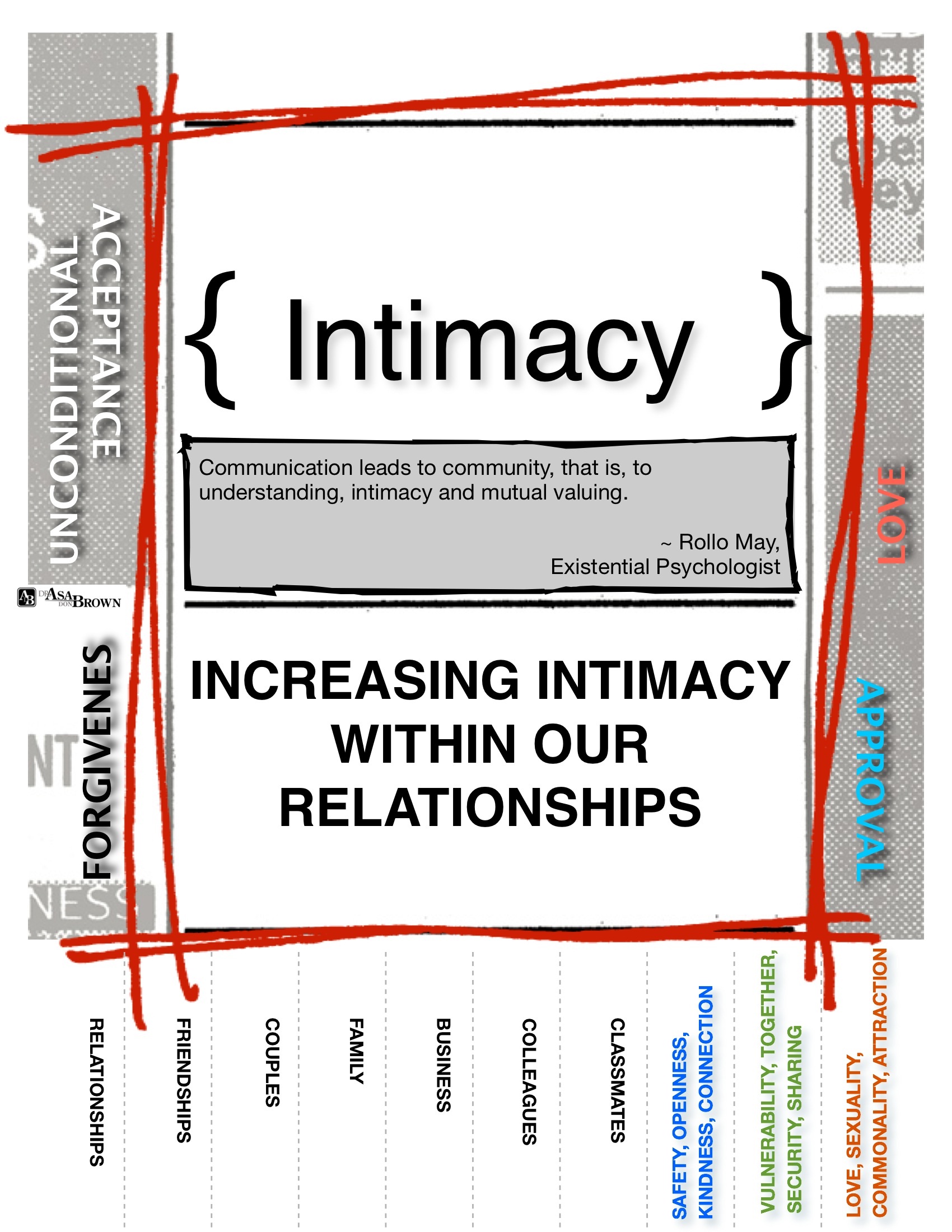
When we hear the word intimacy, all sorts of images maybe conjured up in our minds.  The word intimacy may stimulate a visual image of sexual encounters, or it may project an idea of deeply fostered relationships, but the truth is, intimacy can occur on the most primitive of levels.  Yet, the types of intimacy vary depending upon the depths of the relationship in question.

WHAT IS INTIMACY?

Intimacy is the ability to share an emotional and physical connection with another.  Such connections can occur between couples, friends, families, and within a variety of relationships.  Intimacy involves a level of cohesion that unites the very essence of our person.  It is a connection that can occur on the very basic of human emotions, conditions, and attractiveness.  

Intimacy occurs when we have a bond between ourselves and another person.  Intimacy does not have to occur on a sexual level alone, it can occur between persons who are simply seeking to be connected.  We can be intimate through our verbal and nonverbal gestures, facial expressions, touch, and through the words we choose to use. 

Again, it is important to recognize that it can occur beyond a couple’s relationship, it can occur through friendships, familial relationships and through a variety of close knit avenues and environments. 

Continue reading


*The views expressed by our authors are personal opinions and do not necessarily reflect the views of the CCPA

An Alternative Way of Doing Eat, Pray, Love

Posted by: Hailing Huang on January 25, 2013 3:15 pm

Introduced by a friend, I watched the movie: Eat, Pray, Love and come up with a thought from a counsellor’s perspective: there is an alternative way of doing Eat, Pray, Love, which represents healing, soul discovery and finding balance.

Eat, Pray, Love, Elizabeth Gilbert’s memoir, was on the New York Time best selling list for 199 weeks. Liz, the main character in the movie, is a modern American woman who had what a modern woman wants: husband, country home, and successful career. However, instead of feeling happy and fulfilled, she felt consumed by panic and confusion. After her divorce, she embarks on a journey to Italy, India, and Indonesia to explore three different aspects of her nature: pleasure, devotion and a balance between worldly enjoyment and divine transcendence.

It is glamorous to go around the world and to find the answers. Yet, from a therapist’s perspective, I would like to share with Liz that there is an alternative way of doing this healing. I would suggest a person who is in the same situation could also do some therapy work.

Continue reading


*The views expressed by our authors are personal opinions and do not necessarily reflect the views of the CCPA