Tag Archives: counselling

New Year’s Resolutions

Posted by: Asa Don Brown on January 16, 2015 8:00 am

“Faith is not the clinging to a shrine but an endless pilgrimage of the heart.”  ~ Abraham Heschel

At this time of the year, we are encouraged to develop our New Year’s Resolutions. The resolutions may play upon our heartstrings, moral compasses, religious ideological viewpoints, or the need for physical and mental improvement. Resolutions are not only geared towards improvement of the individual, but as well as the improvement of societies’ moral and ethical compasses. While many may disagree, I unequivocally believe that the key to moving forward, as well as, establishing new pathways in this life, must begin by forgiving ourselves and forgiving others.

FORGIVENESS IS THE KEY TO MOVING FORWARD

“Forgiveness is not an occasional act; it is a permanent attitude.”  ~ Martin Luther King, Jr.

A key to moving forward, is forgiving others, as well as your own person. Forgiveness is not only a state of mind, but it is a state of being. It is woven through the very essence of our being. Forgiveness is a constant attitude occurring through a purposeful action. As humans, we are instinctively designed to forgive. It is only when we choose not to forgive that our minds, bodies, and spirits begin to experience disrepair. Those who choose not to forgive; choose to harbor the wrongs of others and of their own person. Thus, frequently developing physiological and psychological signs and symptoms associated with stress, anxiety, and depression. Forgiveness cleanses the body, ridding it of the decay of negativity, disappointment, and heartache. It is through the act of forgiveness, that we can live a balanced and well-adjusted life. Forgiveness is the key to living life productively. Being productive enables us to be effective in this life, by producing the desires and intended results with which we may choose to acquire. Forgiveness is a purposeful action filtered through a permanent attitude.

WHAT IS A RESOLUTION?

“For last year’s words belong to last year’s language And next year’s words await another voice.” ~ T. S. Eliot

The basic principle of a resolution is to be firm with one’s decisions, opinions, intentions, and expressions. It is through a resolution that we clarify our stance, becoming a decisive person. Being decisive is intent on settling an issue or a set of issues, by producing a definite result.

Continue reading


*The views expressed by our authors are personal opinions and do not necessarily reflect the views of the CCPA

Emotional Health and the Power of Vulnerability

Posted by: Hailing Huang on January 15, 2015 10:24 am

Reflections on the Suicides of Chinese International Students

Recently stories about two Chinese international students committing suicide circulated on Chinese We-Chat. Both students were regarded as excellent students in the eyes of their parents and the others:  they were outgoing, active in the community and academically driven.  So what led to this tragedy?    Who should take the responsibility? What are the causes?  And what can we learn from those tragic?

Such questions linger in the minds of parents, friends, teachers and many others- we want answers. Some people may blame the family’s lack of parenting education, some may blame society’s ideology around success and some may blame the victim for not being tough enough.

TWO CASES

Case one: YuanYuan from Nangjing China, committed suicide in Feb 2009. She was a second year economics student at Amsterdam University. The three notes she left behind disclosed:  “I am so, so tired. For the last eight years I have been trying to calm down the upheaval of inner turmoil; when it hits me I felt so helpless. Sometimes I have to endure and wait for the turmoil to fade and recover slowly.  Life is so busy; I simply do not have time to deal with it anymore. I cannot sense any joy in life, and life itself has become unbearable.  I am really tired of this.”   She also disclosed that she had battled with OCD for the last eight years.

This case was brought to the limelight by Yuan Yuan’s mother. In her mother’s eyes, her daughter was very considerate, independent, warm hearted, decisive and academically driven- a person who had always presented herself as positive and cheerful. The death of her daughter devastated the mother, what had gone wrong?  As a teacher herself she asked what can be done to prevent this kind of thing from happening again.

Case two: Guo Yanjun, 28,   immigrated to America in 2001, graduated with an Honors BSc in 2006, worked in investment banking in New York, then registered at MIT (麻省理工学院),majoring in management – a journey much admired by many Chinese students.
Continue reading


*The views expressed by our authors are personal opinions and do not necessarily reflect the views of the CCPA
Procrastination, Burnout and Support

Posted by: Bhavna Verma on January 15, 2015 10:11 am

It’s so easy to put aside the ‘to do’ list when you’re not in the right state of mind. For example, these blogs need to be submitted bi-weekly; and I, admittedly have not been submitting the blogs on time. I’m sure there are others out there like me which makes me feel validated and normal. But the blogs are not intensive; they are literally between 350-500 words which don’t take too long to produce. So, why has it taken me so long to complete and submit them? Because, my mind, heart and soul just weren’t in it. Recently, there have been a multitude of stressors in my life that have forced me to push aside projects to the back burner. And eventually, insight hit! Suddenly, it occurred to me that I was no longer in the mood to work on the blogs or other projects. I knew that the submission date was coming up, but had no inkling to work on it. We all know that lack of excitement or the pleasure feeling from activities we enjoy is a symptom of burnout. But it is up to us to become aware of the feeling and decide how long this feeling will continue for. At some point, I had to force myself to get my act together, and jump back on the wagon. I’ve committed myself to projects, and I need to follow through with them. Once I labeled my emotion towards the pending projects, it became easier to tackle them. Another variable which I feel is important is that once you have labeled the stage of burnout, you need to inform others too, such as your boss or co-workers; or even Stephanie Ross, who diligently uploads the blogs. Support from family and friends are a must in order to come out of burnout, as it is so easy to get lost in the process. This may just make you feel even worse and perpetuate the symptoms. Express to your family and friends what support you feel you need from them, as it could be different for each person. By specifying what you need, you alleviate doubt and wonder that they may be having as they may not be sure how to help you, and unintentionally end up doing more damage than good. To me, this is also a sign of insight and awareness, as you are able to recognize what helps and what doesn’t.


*The views expressed by our authors are personal opinions and do not necessarily reflect the views of the CCPA

The Career Buzz Podcast: Craig Dowden on Fixing Disrespectful Workplaces

Posted by: Mark Franklin on January 15, 2015 10:08 am

The Career Buzz Podcast: Craig Dowden on fixing disrespectful workplaces

dowdenWhat happens in a respectful workplace? “People feel understood, they are comfortable expressing who they are, and they respect each other’s boundaries,” Craig Dowden, PhD, told Career Buzz listeners on Nov. 26, 2014. Craig was the MC of this year’s Your Workplace conference and as a leadership and organizational excellence expert, he presented on Respect in the Workplace — Easy to practice and costly to forget.

I asked Craig to describe what happens in a disrespectful workplace: “Checking email during a meeting is a strong sign of disrespect” because it makes people feel they’re not worth your time or attention. What else? “Talking over people, talking down to people, taking credit for other people’s work.”

What’s the impact? Craig shared that “research says 94% of disrespected people say they’ll get even with the offender, and 88% say they’ll get even with the organization.” Ouch!

What are the clues that apply to you? What does Craig say we should do about disrespect in the workplace? “Take action quickly. Use information from engagement surveys. Conduct exit interviews. Tips: Concerned about respect in your workplace? Craig suggested: “Have adult conversations” and be clear about what you can stand and what you cannot.” For more tips, listen to the interview (Craig is on from 49:25 to end).

Need help finding a respectful workplace for your career? Check our career management programs. Plus, listen to our Career Buzz inspiring archive anytime!


*The views expressed by our authors are personal opinions and do not necessarily reflect the views of the CCPA

How Can a Six-Month-Old Baby be the Best Career Counsellor Ever?

Posted by: Mark Franklin on January 6, 2015 4:46 pm

Naguib Gouda had been working in financial services while at the same time volunteering for non-profits on the side. But, as he told Career Buzz listeners (Dec. 10, 2014), “what I was doing was not enough.” Then, 12 years ago when his daughter was six months old, Naguib said, “she gave me courage to make that career change” into meaningful work in the non-profit sector. How?

Naguib shared this valuable perspective: “If someday in the future she comes to me and says, ‘Hey dad, I’m not happy doing what I’m doing. What should I do?’ I could be the bitter old man who says, ‘don’t make the same mistake that I did.’ Or I could lead by example, and tell her that’s what I did when she was six months old and it worked, and it’s been fantastic.” Twelve years ago Naguib switched to the not-for-profit sector where he’s been in leadership positions ever since, and loving it, now president of Career Edge.

Hear the whole interview (Naguib’s story at 11:30) also featuring Syndey Helland of Career Edge and coach/author Karen Wright.


*The views expressed by our authors are personal opinions and do not necessarily reflect the views of the CCPA

A Life Lived Without Forgiveness

Posted by: Asa Don Brown on October 28, 2014 1:52 pm

“A life lived without forgiveness is a prison.” ~ William Arthur Ward

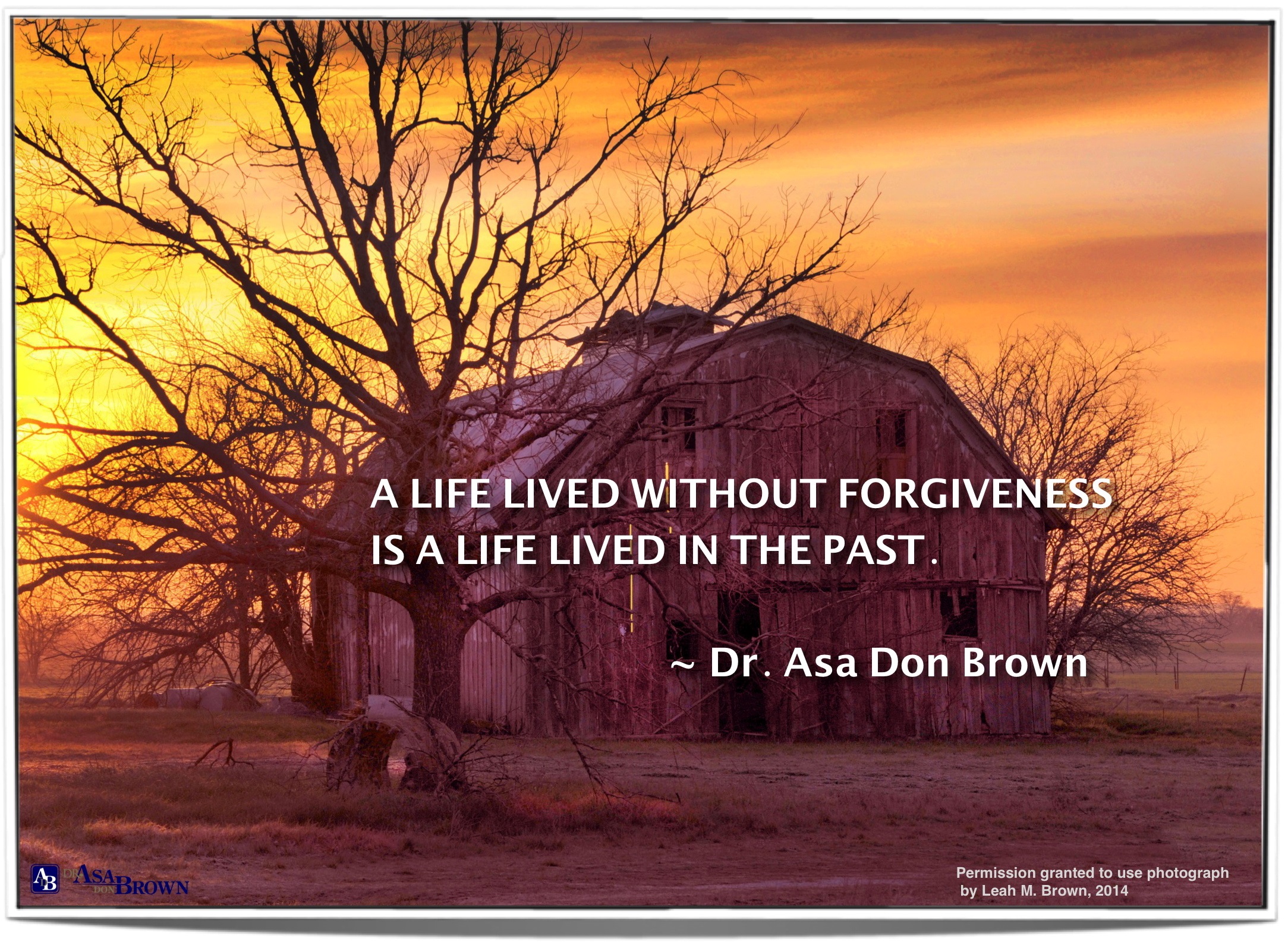
forgiveA life lived without forgiveness is a life lived in the past. Living in the past is a conscious or an unconscious choice made through a connection to the past. In simple, the past is a time gone by and no longer exists in the present moment, but we choose to allow this past to occupy our minds, our bodies and our very existence. Living in the past is like choosing to cling to a chronic illness. Would you choose to be plagued with a chronic illness? Would you allow yourself to be
injected with a disease that could take your life? Why then, are you allowing yourself to be injected daily with the memories associated with the past? Why have you chosen to cling to the negative memories associated with your life? Have you found comfort with the negative memories, or do you feel incapable of letting go of the past?
Letting go of the past is through purposeful action. The action is the process with which we choose to rid the very essence of our person of the past. The past may be comprised of tragic events, thoughts, or circumstances. Whatever the case, the past is haunting you and it is denying you the freedom of moving forward in this life.
As a clinician and a person, I have been witness to countless individuals who have chosen to cling to the past. Clinging to the past is a purposeful action of recalling, remembering and harboring negative thoughts, deeds or actions. When we harbor the memories associated with the past, we are protecting the negative memories, rather than allowing them to exist no more. Moving beyond the past requires a combination of actions: letting go, forgiveness, and moving forward.

FORGIVENESS IS A STATE OF BEING

Forgiveness is not only a state of mind, but it is a state of being. It is woven through the very essence of our being. Forgiveness is a constant attitude occurring through a purposeful action. As humans, we are instinctively designed to forgive. It is only when we choose not to forgive that our minds, bodies, and spirits begin to experience disrepair. Those who choose not to forgive; choose to harbor the wrongs of others and of their own person, frequently have physical and psychological signs. Forgiveness cleanses the body, ridding it of the decay of negativity, disappointment, and heartache. It is through the act of forgiveness, that we can live a balanced and well-adjusted life. Forgiveness is the key to living life productively. Being productive enables us to be effective in this life, by producing the desires and intended results with which we may choose to acquire.

FORGIVENESS OF OTHERS

Forgiving others, especially our enemies, is a challenge indeed. What if, you had committed a wrong against another? Would you not have a deep desire to be forgiven? Have you ever experienced the denial of your repentance? What sort of effect did this have on your person? Were you shattered by the unwavering and unyielding of the person or persons you had wronged?
As a clinician, I have met a variety of patients / clients who’s hearts ache to be forgiven. As an individual, I too have had the experience of others denying the acceptance of my repentance. The denial of our repentance can have a penetrating effect, plunging like a dagger deep into the very core of our being. For so many, forgiveness and the lack of forgiveness, can prove a major stumbling block.
If we deny accepting the repentance of another, then we are intentionally and purposefully hanging on to the wrongs of the past. The wrongs of the past serve as a coat-of-arms. We identify our coat-of-arms as a shield of honor, but the reality is, our coat-of-arms is shielding the very nature of our person from allowing others to enter. It is serving as a warning sign, informing others to tread lightly because I will remove them from my life, if they wrong me.
For people who long for the acceptance of their repentance, they will continue to be haunted by their past wrongs as long as they choose to hang onto them.

Continue reading


*The views expressed by our authors are personal opinions and do not necessarily reflect the views of the CCPA

The Loss of a Child

Posted by: Asa Don Brown on October 7, 2014 12:55 pm

“To lose a child is to lose a piece of yourself.”  ~ Dr. Burton Grebin

child lossThere is no greater grief, than when a parent losses a child. As a person, I had never truly experienced such a gut-wrenching heartache, until the day that my wife and I lost a child. As a therapist, some may think that I am trained to have “all the known answers,” but the truth is, there are no answers, quick fixes, or remedies to mend the heartbreak around the loss of a child.

The loss of a child is an inconceivable and it is an unimaginable experience. While my wife and I never had an opportunity to get to know our child by physical touch, perception, or smell; we had already bonded with our developing child.

MY DAUGHTER’S HEARTACHE

The day that we were told that our child had passed on, was the most egregious experience of my life. On this very day, not only had I lost my child, but my precious and tendered hearted Delilah experienced the loss of a sibling. At the time, my daughter was a mere 5 years of age, but her cry and her mournful spirit penetrated the very nature of my being. At that moment, I recognized not only the impact that this loss had on myself, my loving wife, but the dire impact that it had on my precious daughter. For me, the loss was like an ocean of emotions consuming my person, but it was further deepened by witnessing the breach of my daughter’s innocence. Furthermore, it was the tenderness of my daughter’s cry that pierced my heart and my soul. It was like I had experienced yet a second loss, a loss of my precious daughter’s innocence and my inability to protect her from harm that broke my spirit.

Continue reading


*The views expressed by our authors are personal opinions and do not necessarily reflect the views of the CCPA

Spare the Rod

Posted by: Asa Don Brown on September 26, 2014 8:24 am

“Power is of two kinds. One is obtained by the fear of punishment and the other by acts of love. Power based on love is a thousand times more effective and permanent then the one derived from fear of punishment.” ~ Mahatma Gandhi

spare the rodThe argument for corporal punishment has been the longstanding acceptance by those who have endured this form of punishment. The debate for corporal punishment has varied from religious instructions to parental rights. Corporal punishment has not only been excused by religious texts, familial familiarity, and governmental avoidance of change; it has been made allowable because of its longstanding relationship with society. “My father did not spare the rod, therefore I won’t spare the rod either.”

Parents, teachers and school administrators have frequently argued that there are no, or limited, alternatives. For a number of parents, religious leaders, teachers, and school administrators the argument is corporal punishment will realign and adjust a child’s behavior.

THE ARGUMENT FOR CORPORAL PUNISHMENT

The Canadian Parliament has ruled in Section 43 of the Criminal Code that:

Section 43 of the Criminal Code reads as follows:

            Every schoolteacher, parent or person standing in the place of a parent is justified in  using force by way of correction toward a pupil or child, as the case may be, who is  under his care, if the force does not exceed what is reasonable under the circumstance.

Continue reading


*The views expressed by our authors are personal opinions and do not necessarily reflect the views of the CCPA

I Feel Like a Flower Waiting to Bloom….

Posted by: Priya Senroy on May 16, 2014 3:33 pm

Dear fellow counsellors….YES…SPRING is finally here…I am seeing it in my backyard…although the weather is enigmatic as ever…I try to find some meaning in its  forecasts, try to make sense of the erratic nature…..this year is going to be unpredictable and I need some kind of roots to ground me—speaking of metaphor—while doing spring cleaning…I found my old metaphor cards and have used them  occasionally with my clients….the results have been better than our weather forecasts—each time I use them, they  are interpreted in amazing ways. I was first introduced to them as a young fledging Drama and Movement Therapist- we were encouraged to embody the images and then dramatize the associated feelings and metaphors…they can be defined as therapeutic tools that  open a window into a person’s inner world; associative reactions to the illustrated cards make it possible to reflect upon childhood memories, to recall repressed experiences, and to release blocked feelings. Since the interpretations of metaphors featured in the cards are completely in the eyes of the beholder, the same card can trigger different reactions in different participants (OH cards institute 2014) There are many kinds of cards, I use ECCO which are just one of the few decks out there .If anyone is interested in finding more about these cards which are specially useful when words are not enough to express how one feels. I became more fascinated by them when one of my favorite therapists-Mooli Lahad spoke of them. He has  quoted  about them in another site as (the) cards help us create a space in which we allow ourselves to invent, make believe and day dream, while knowing all along that the “fantastic reality” is there to serve our coping skills and not in order to cut us off from reality (Lahad, 2003).

I can go on and on….but I think I will leave you with websites that can shed more light on them and hoping that they will inspire to be used as an effective creative therapeutic tool in counseling:

http://www.oh-cards-institute.org/wp-content/uploads/2012/02/Chen-Nicole-International-Conference-Experiential-Card-Therapy-v2.pdf

http://www.oh-cards-na.com/areas-of-use/therapy-and-counseling/

http://www.oh-cards-institute.org/2012/metaphoric-cards-an-effective-tool-in-therapy/


*The views expressed by our authors are personal opinions and do not necessarily reflect the views of the CCPA

Lost In Translation

Posted by: Priya Senroy on April 25, 2014 3:40 pm

I am hoping that Spring is finally here and we can get liberated from the scarves and the tons of clothing which I am finding is restricting my body language and sometimes I am also finding it difficult to read my client’s body language. This is especially true for clients in counseling who find it challenging to communicate using words and use their bodies primarily. We know that in counseling, body language is used to help build rapport, by observing the clients body movements and matching them in an appropriate way it can improve communication. On an unconscious level mirroring the clients movements can help them feel more comfortable with their counsellors; reason being people feel more connected to the people who are most like themselves. The counsellor observes the client’s body language at all times, noting any discomfort, as this could indicate difficulty verbalizing something, and further exploration can be carried out to connect to the client’s deeper feelings. Body Language is the unspoken communication that goes on in every face-to-face encounter with another human being. It informs us the true feelings towards us and how well our words are being received by others. I found an acronym in a website which helps me to remember that dos and don’ts of using body language as a counsellor-it is important though to remember that every client t is different and every situation is different so it is important to make sure that using body language takes into  account the  diversity,culture, gender , ethnicity etc. So the acronym SOLERF stands for

S – Squarely face person vs. sitting kitty-corner.

O – Use Open posture vs. crossed arms and legs

L – Lean a little toward the person vs. settling back in your chair

E – Use Eye contact vs. staring off into deep space

R – Relax; keep it natural vs. sitting like a board

F – look friendly vs. neutral or scowling.

For me, every client is always feeling much more than what they are saying and it is important to  be aware of my own body language and making sure that I am keeping the communication simple and make sure that nothing is lost in translation.

Priya Senroy


*The views expressed by our authors are personal opinions and do not necessarily reflect the views of the CCPA